Holding AI accountable when systems cause real-world harm
Artificial intelligence is now embedded in hiring tools, chatbots, recommendation engines, and countless “smart” products. When AI causes business damage, financial loss, or consumer harm, the fallout can be immediate and severe.
AI Liability Attorneys represent consumers and businesses in disputes, investigations, and lawsuits arising from unsafe, deceptive, or defective AI products and services.
If you believe you or your business has suffered damages from AI, contact our team today for a free consultation.
What Is AI Liability?
AI liability arises when an AI system or AI-driven product causes financial, reputational, emotional, or physical harm. This can include faulty recommendations, biased decisions, misuse of personal data, or dangerous interactions with AI chatbots or virtual agents.
Common AI liability theories include negligence, product liability, unfair or deceptive trade practices, privacy violations, discrimination, and misrepresentation about what an AI tool can safely do. These theories are being applied to traditional software, but regulators and courts are quickly adapting them to AI-enabled tools and services.
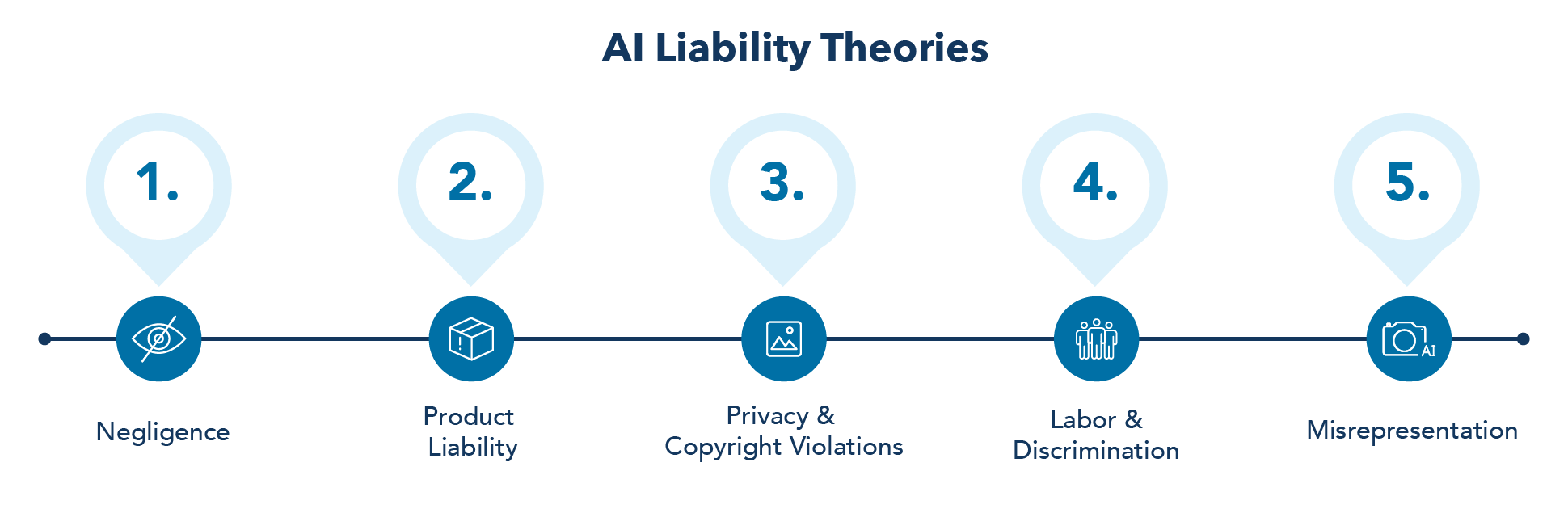
Litigation Addressing Harm from AI
AI tools increasingly shape what people see, buy, and do. When those tools fail, consumers can suffer serious harm, such as:
Financial losses from misleading investment, lending, or purchasing recommendations generated by AI.
Emotional or psychological harm from unsafe chatbot interactions or AI tools that encourage self-harm or risky behavior.
Damage to reputation or opportunities when AI content or outputs spread false information about a person.
Invasive use or misuse of personal data in AI training or deployment, without proper consent or safeguards.
The firm helps individuals and groups of consumers pursue claims where AI products are unsafe, deceptive, or deployed without reasonable protections.
Business Damages from AI
Businesses rely on AI to automate decisions, analyze data, and interact with customers. When AI malfunctions or is misrepresented, the business impact can be immediate:
Lost revenue and customer churn due to inaccurate predictions, scoring models, or recommendation engines.
Contract and vendor disputes when AI tools do not perform as promised or introduce unacceptable legal and compliance risk.
Reputational damage from AI-generated content, hallucinated information, or biased outputs tied to your brand.
Regulatory scrutiny triggered by an AI vendor’s practices, even when your company is merely a customer or integration partner.
The firm represents businesses that have been harmed by AI vendors, platforms, and technology partners that failed to deliver safe, lawful, and transparent AI solutions
AI Liability Litigation
Competition and antitrust harms
When a few large firms control data, compute, and key AI platforms, AI can reinforce monopolies and raise antitrust concerns. Potential legal issues include:
Exclusionary conduct (e.g., using proprietary models and data advantages to block rivals), relevant to antitrust laws on abuse of dominance or monopolization.
Anticompetitive vertical integration, where dominant platforms bundle AI services in ways that foreclose independent competitors or impose unfair terms.
Discrimination, labor, and employment harms
Excessive application of AI in automation, wage suppression, and failure to improve worker productivity intersect with employment and antidiscrimination law. Legally significant harms include:
Indirect discrimination where automated hiring, firing, or scheduling systems embed biased patterns, triggering liability under equal employment and civil-rights statutes.
Unfair labor practices, such as using opaque monitoring and algorithmic management to undermine collective bargaining, workplace rights, or minimum-wage and overtime protections.
Privacy and data protection harms
AI systems often rely on massive data collection, creating significant privacy and data protection exposure. From a legal perspective, this can involve:
Unlawful processing of personal data, including opaque profiling and inference of sensitive traits without valid consent or legal basis under data protection regimes.
Inadequate security and data minimization, leading to regulatory liability for breaches or overcollection, and potential civil claims for misuse of personal information.
Consumer protection and unfair practices
AI-driven personalization can narrow consumer choice and enable manipulative design, which has consumer protection implications. Relevant legal risks include:
Deceptive or unfair commercial practices, such as misleading recommendations or dark pattern interfaces that exploit behavioral data to steer consumers.
Asymmetric contract terms embedded in AI-mediated platforms (e.g., clickthrough terms) that regulators may challenge as unfair or unconscionable when combined with AI-driven information advantages.
Personal injury or Bodily Harm
AI accidents arise when AI systems act in unexpected or unsafe ways, leading to harm in everyday settings. These incidents typically blend technical failures with human mistakes, such as overreliance on automation or delayed intervention. Common patterns include:
Transportation incidents, where automated driving systems misread road conditions or miss obstacles, and human drivers fail to take over in time.
Healthcare mishaps, where AI-guided tools or diagnostic systems provide wrong outputs that clinicians rely on too heavily, contributing to injury or misdiagnosis.
Workplace and industrial failures, where algorithmically controlled equipment behaves unpredictably or is misconfigured, putting workers at risk.
AI induced psychosis
Household and consumer device malfunctions, where smart systems operate at the wrong time or in the wrong way, causing physical hazards like burns, falls, or collisions.
In most of these situations, the harm is not caused by the AI system alone but by an interaction between design flaws, inadequate oversight, and human complacency or misunderstanding of the system’s limits.
Use of third-party AI tools with confidential data
Companies are also litigating situations where employees feed confidential information into external AI services, arguably destroying secrecy or transferring it to third parties.
A recent case involving use of an AI meeting transcription tool (Otter) alleges that a former employee recorded confidential sales calls using an unauthorized AI program, with plaintiffs claiming misappropriation under the Defend Trade Secrets Act and breach of contractual confidentiality obligations.
Trade secret disclosure via prompts
When employees paste proprietary content (source code, design documents, pricing models, client lists) into public LLMs, the business can lose effective control over that information and jeopardize trade secret status.
Inputs may be stored on the provider’s servers and used for further training, creating a risk that fragments of the secret later surface in responses to third parties, erasing the secrecy that underpins competitive advantage.
Real-world incidents (such as engineers submitting confidential code to public chatbots) have already led companies to restrict or ban use of external LLMs, recognizing that this kind of leakage can irreversibly erode their market position.
trade secret cases involving theft of AI system prompts through “prompt injection attacks.”
Copyright and IP value erosion
LLM training and outputs can harm the economic value of an artist's s, even if courts ultimately find training to be fair use in some contexts.
AI that trains on copyrighted datasets without licenses can lead to intellectual property damages claims, especially where inputs include pirated content or where outputs closely track protected works.
Even when outputs are nonidentical, courts have commented that LLMs can flood the market with similar works, diluting demand for original material and undermining licensing markets, which can be framed as economic “market harm” to the IP owner.
Defamation tort claims
If AI-generated content has caused you harm—such as defamation or damage to your reputation
Get Legal Help Now
Have a matter concerning
AI Harm and Liability?
We welcome you to submit your details using our contact form
Associate Galen Cheney Featured for Crypto Litigation Insight
February 26, 2026
See Article: https://poliscio.com/crypto-pardon-doesnt-end-troubles-for-zhao-binance/ Galen Cheney (Associate) was recently featured in PoliScio’s FOIAengine coverage of the continuing legal and regulatory fallout surrounding Binance and its founder, Changpeng “CZ” Zhao. In the...
Press & Published Articles
A New Path to Justice: Cryptocurrency Exchanges Can be Held Liable for Pig Butchering and Elder Financial Exploitation and Abuse
September 12, 2025
As a major update in the firm’s elder financial abuse cryptocurrency lawsuit, the District Court for the Northern District of California, in a groundbreaking order in the case of Lee...
General News & Firm Announcements
Firm Serves as Co-Counsel with Silver Miller Against Charles Schwab, Bank of America, and Unchained Trading
November 22, 2024
Kronenberger Rosenfeld, LLP, and its co-counsel Silver Miller, filed a federal lawsuit in the District Court for the Northern District of California that highlights the ever-growing concern of elder financial...
General News & Firm Announcements
Firm Takes Aim Against Elder Financial Abuse in Cryptocurrency Scams
July 19, 2024
New Update (September 2025) See complaint here. Kronenberger Rosenfeld, LLP has filed a groundbreaking complaint in San Francisco Superior Court, highlighting the growing epidemic of elder financial abuse in America...
General News & Firm Announcements
How to Fight Back Against Anonymous Online Attacks
September 2, 2021
Malicious Posts On The Rise We live in a time when anyone can anonymously attack another person online. It’s as simple as creating an anonymous blog or setting up a...
Resources & Self-Education
Be Careful What You Click On
June 4, 2018
That URL Typo Can Break Your Bank Account It’s an easy mistake to make, and it can be costly. Click on the wrong link, or type the wrong keystroke and...
Resources & Self-Education
Categories
Try typing keywords like FTC, Advertising, Trademark, etc...