
Federal Trade Commission (FTC) Civil Investigative Demands
So you've received a demand letter from the Federal Trade Commission... what now? Here's what to expect from a Civil Investigative Demand.
What Is an FTC Civil Investigative Demand?
A Federal Trade Commission (FTC) Civil Investigative Demand (CID) is a type of administrative subpoena with teeth. It is one of the key investigation tools the FTC uses. Under Section 20 of the FTC Act (15 U.S.C. § 57b-1), the FTC has broad authority to compel any person or company to produce documentary materials, submit tangible things, file written reports, answer interrogatories under oath, or provide oral testimony.
Does Receiving a CID Mean You're Being Sued?
Not necessarily, but receiving a CID means the FTC has reason to believe your company may have information relevant to an investigation, and that investigation might be about you. It might also be about a competitor, a vendor, or the entire industry sector you operate in. A CID should be taken very seriously, ideally with experienced FTC counsel.
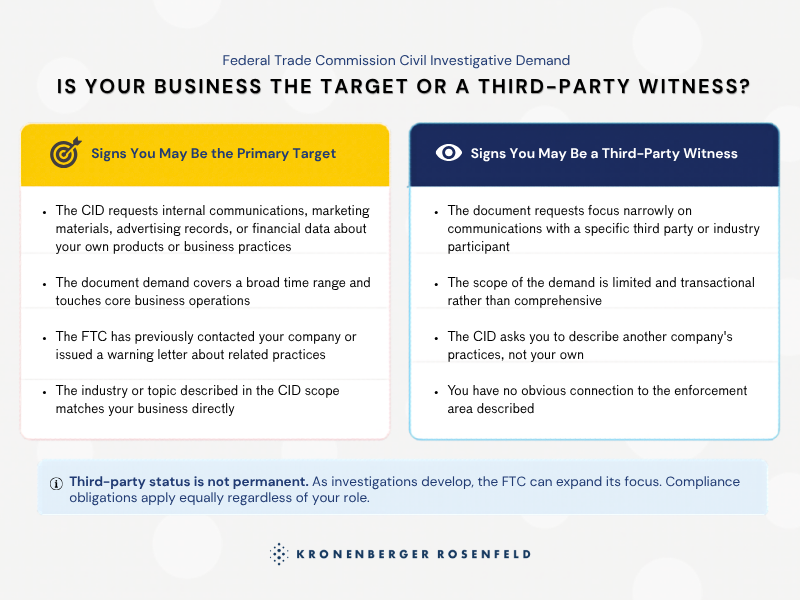
The FTC’s Bureau of Consumer Protection (BCP) often uses CIDs to investigate possible unfair or deceptive acts or practices under Section 5 of the FTC Act and related FTC Rules. A CID is not a lawsuit; – it’s a formal demand for information that the FTC believes is relevant to an open investigation. However, lawsuits or other enforcement may also arise after the CID process, or in some cases, lawsuits may be filed before any CID to the defendant.
What Triggers an FTC CID?
Before the CID even arrives, the FTC has usually been watching for some period of time. Common CID triggers include consumer complaints, tandem investigations, media coverage, competitor tips, or industry monitoring by FTC staff. In other words, the FTC has some indication that there are alleged unfair or deceptive business practices, whether by the CID recipient or a third party under the CID’s scope. Examples of triggers include:
- Complaints filed with the FTC or the Better Business Bureau
- Parallel investigations being run by state Attorneys General
- Media coverage of alleged deceptive business practices
- Complaints from competitors
- Active industry-wide monitoring
How to Respond to an FTC CID
1. Take it Seriously and Issue a Hold on Document Destruction Immediately
CIDs should be taken seriously and escalated as needed. As an initial step, you need to stop all routine document destruction. Suspend email purge policies, auto-delete settings on messaging platforms, and any scheduled data deletion processes.
Federal law requires that CID recipients preserve all documentary material that could reasonably relate to the investigation, regardless of whether those documents are privileged. If you destroy documents after receiving a CID and the FTC finds out, you may have a much larger problem than whatever the original investigation was about.
2. Note Key Deadlines
Your CID will have two deadlines clearly printed on it. First, the response deadline, which is when your document production, interrogatory answers, or other materials are due. Second, the meet and confer deadline. Missing either without communicating in advance can trigger enforcement proceedings. In sum, you should take note of the Response Deadline and the Meet and Confer Deadline.
Deadline 1: Meet & Confer | Deadline 2: Response / Production | |
Timeframe | Within 14 days of service (waivable by agreement with FTC staff) | Typically 3–6 weeks from service as stated on the face of the CID; extensions are common |
What It Is | A required conference — by phone or in person — between your counsel and the FTC attorney assigned to the matter | The date by which you must deliver all responsive documents, interrogatory answers, tangible materials, or oral testimony specified in the CID |
Purpose | Clarify the scope of the demand, ask questions about the investigation, raise objections, negotiate production logistics, and request modifications or extensions | Complete compliance with all non-objected-to portions of the CID under oath and sworn certificate of compliance |
Your Leverage | This is your best opportunity to narrow the demand. Scope modifications, schedule adjustments, and format agreements must be raised here — not after the fact | Extensions are routinely granted if requested in advance and in good faith. Do not let this date pass silently |
If You Miss It | FTC may proceed without input from you. You also lose the right to raise concerns before a petition to limit or quash | FTC may seek judicial enforcement. Courts have broad authority to compel compliance and impose sanctions |
Petition Window | You must raise objections at the meet & confer before filing a petition to limit or quash | 20 days from service to file a petition to limit or quash under 16 C.F.R. § 2.10 — before the return date, whichever comes first |
First Step | Issue a litigation hold immediately, then retain FTC defense counsel before this meeting | Begin document collection and privilege review the same day you receive the CID |
3. Retain Experienced Counsel
Experienced FTC defense attorneys can help you understand the scope of the demand, negotiate the timing, scope, and potential objections, identify legitimate privileges, and develop a response strategy that does not inadvertently expand the investigation. Attorneys who specialize in FTC matters understand how these proceedings develop and can help you avoid the most common mistakes companies could make.
If you have received a Civil Investigative Demand from the FTC or any regulatory body, our team can help you prepare a response. Contact our team today for a free consultation.
4. Schedule the "Meet and Confer"
The FTC's Rules of Practice require a meet and confer session within 14 days of receiving the CID, although this deadline can be waived. This meeting is your first and best opportunity to ask questions, clarify confusing document requests, discuss scheduling constraints, and potentially narrow the scope of the FTC requests.
The FTC attorney assigned to your matter may tell you more about the nature of the investigation. In many cases, a direct conversation between them and your FTC defense lawyer will lead to a more workable production and response process, including by negotiating the timeframe to respond. Companies that engage constructively, professionally, and consistently typically fare better than those with an unwarranted adversarial or evasive approach.
What Does Compliance with an FTC CID Actually Look Like?
A CID can require some combination of documentary production, written interrogatory responses, production of tangible things, and oral testimony from company representatives. Each category has specific requirements by law.
For example, document productions must be made pursuant to specific metadata requirements and under a sworn certificate certifying that you have produced all responsive materials in your possession, custody, or control. Interrogatory responses must be answered under oath, separately and fully for each question. If you are objecting to any portion, you must state the reasons in writing rather than simply leaving questions unanswered.
Recent FTC guidance is explicit that the agency may ask you to sign a tolling agreement, which is a formal contract pausing the statute of limitations while the investigation is pending. This is usually standard practice and gives both sides time to work through a complex production. While it is not something to resist reflexively, it is one example of something that can be reviewed with experienced FTC counsel.
How To Challenge a CID
It is possible to challenge a CID, but you need to move fast and understand what you are doing. Under 16 C.F.R. § 2.10, you have 20 days from service (or before the return date, whichever comes first) to file a petition to limit or quash the CID. This petition asks one of the FTC Commissioners to either narrow the demand or withdraw it entirely.
The FTC will not consider your petition unless you have already raised your concerns at the meet and confer. The petition must be no more than the word limit and must set forth all factual and legal objections, including any privilege claims.
Filing a petition does not pause your obligation to respond to the portions of the CID you are not challenging. You must continue complying with those sections by the deadline. Because petitions to limit or quash are public records, they will appear in the FTC's public docket. Therefore, it is important to consider whether filing a challenge to a CID is truly in your company's best interest and how to preserve any confidentiality arguments.
What Happens After You Respond to a CID?
As the FTC's guidance for small businesses explains, there are a few possible outcomes after a CID. Once the FTC staff reviews the materials sent in response to the demand, one of three things typically happens:
1. The agency closes the investigation with no further action.
2. Staff approach your company about negotiating a settlement or consent decree.
3. If no settlement is reached, the Commission may file a lawsuit.
Specifically, after you complete your production, FTC staff will review everything submitted and ordinarily provide you with a status update. Three general outcomes are possible: the investigation closes with no action, staff recommends negotiations toward a consent decree, or the matter proceeds to formal enforcement proceedings. A consent judgment or enforcement action may be brought in administrative or federal court.
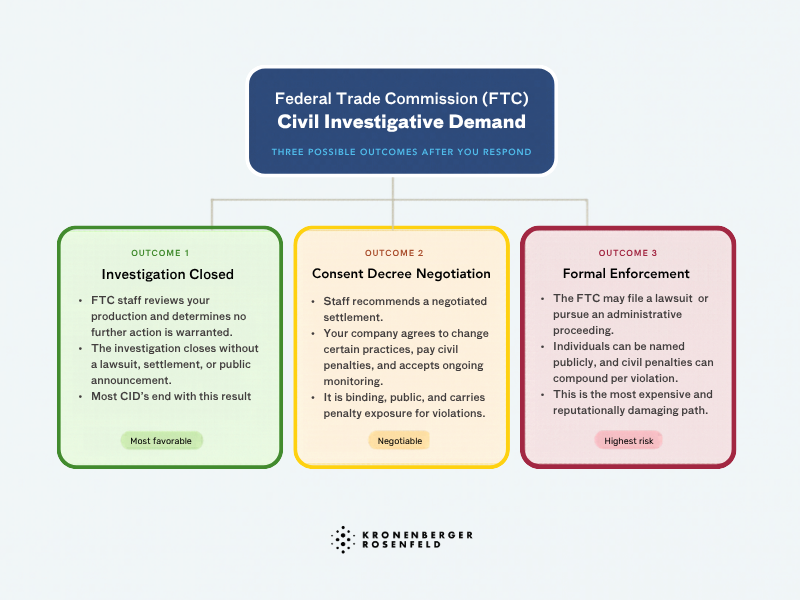
A consent decree (sometimes called a consent order) is a negotiated settlement that typically requires your company to change certain practices, pay redress and/or civil penalties in some cases, and submit to ongoing monitoring. It is not a criminal conviction, but it is a binding agreement with the federal government, and it is public. Many businesses are concerned about the reputational harm they may face if and when a court order or complaint is filed and the FTC issues public press releases, usually naming individuals.
If you reach the enforcement stage without a settlement, the Commission may recommend filing suit in federal court or pursuing an administrative proceeding. That is a long and expensive road that most companies, given the choice, prefer to avoid through early and good-faith engagement. However, litigation decisions may depend on various factors, including potential defenses, novelty of issues, budget for a defense etc. Once a lawsuit is filed, the parties may still decide to settle at any point.
An FTC Civil Investigative Demand is serious, but it is manageable if you respond strategically and immediately. The worst outcomes in CID matters often trace back to the same early mistakes: inadequate litigation holds where key records are destroyed, hiding assets or information, or delaying reaching out to the FTC by treating the process as something that might go away without a reasonable response and compliance.
The FTC expects complete, timely compliance, and it will seek judicial enforcement when companies fall short. If you need assistance responding to an FTC CID, contact our team today.
Fully describe the facts of your personal experience / legal matter (the other parties involved, followed by a brief chronology of the facts, the nature of the dispute, and your objective, etc.):