KR Report: SXSW 2026 Roundtable Discussion
LISTEN HERE
TRANSCRIPT
Disclaimer, this podcast is for educational and entertainment purposes only. Nothing heard on the show is considered legal advice and listening does not create an attorney-client relationship with Kronenberger Rosenfeld or any of its lawyers.
[Katy]
Hi everyone, thanks for joining. My name is Katy and I am the Director of Marketing here at Kronenberger Rosenfeld. I am also joined today with Halie, our Associate Director of Marketing, and Andrew, our attorney that specializes in music and intellectual property matters. The three of us just got back from South by Southwest and we are here today to kind of discuss some takeaways as well as, you know, talk about AI as that was the cornerstone of the entire event.
The same question kept appearing over and over again, is AI going to supercharge creativity or drown us in its noise and how do we keep up while still staying ahead? That is very confusing, but that is basically what all the discourse was this week. For context, Halie and I, this is our first time ever going to South by, so we did not have any expectations going in.
We just knew that this was the first time there was going to be a lot of intersection between innovation, music, and film and TV. So for us, it was a new experience, but for Andrew, how many times have you been to South By?
[Andrew]
I've been three times before. I went twice when I worked at an independent record label and then I went once when I was a law student.
[Katy]
Just to get things started, what is one word to describe everyone's South By experience?
[Halie]
I know it's not one word, but I'd say “first-rodeo.” We've been to a few different conferences and marketing events, but this was, you know, something of a whole new level and I think now we have more of an idea of what to expect next year and how to prepare.
[Katy]
We can hyphenate first dash rodeo to make it work. What about you, Andrew?
[Andrew]
Busy, you know. I was out there every day going to panels throughout the day, going to showcases in the evening. You know, this is the first time that they've had the music, tech, and film and TV tracks all overlapping at the same time.
It was very busy, a lot of energy. It could be a little overwhelming, but also it led to a really interesting intersection of overlap of these occasionally disparate areas of focus.
[Katy]
Without thinking about it, my brain was like, innovative, and I was like, that's literally one of the name of the tracks, so I think that's cheating. So I think I would say “stimulating.” Similar to Halie’s point of just, we haven't really had this type of experience where we were living on a college campus for a week and it was just go, go, go. There was not a second to really sit down.
We would be going to marketing and innovation conferences all morning, afternoon, maybe catch a film or TV premiere in the evening, and then go to a concert late at night. It's just, you always were on the go and having that kind of experience very much differs from just a nine-to-five conference that we've attended in the past.
What was everyone's biggest, oh, wow moment at South By that genuinely took you aback, which could either be, oh wow! or, oh… wow…
[Andrew]
You know, one of the things that still always impresses me at South By Southwest is just how much incredible music talent there is, be it at the official showcases or even just when walking down 6th Street in downtown Austin, you know, I'll walk outside a bar and hear someone just absolutely ripping on guitar, walk down to the next bar and there's a fantastic drummer. The talent's all around. It's always the nice thing about South By Southwest.
You can really kind of walk into any random venue in Austin and just hear amazing music, be it local musicians or musicians who came in specifically for the festival.
[Halie]
I think the premiere of I Love Boosters was really cool. I've been to a few different movie premieres before in London, but this was really cool to see how accessible it was. I mean, it was right in the middle of town where people who were at the festival or just locals were able to see all the excitement and be part of the experience, and then being able to see all the stars on stage and be able to connect with them and then watch the movie as one of the first audiences was really cool.
[Katy]
For me, it's just the approachability of the attendees I thought was very compelling. You know, at other conferences, since you're just, you know, trying to go to sessions, there is some networking, but usually those are kind of forced by, you know, networking events or mixers or things. It just felt like everyone had a genuine interest in wanting to connect.
If you were standing in line for something, if you were walking down the street, you know, people were very interested in each other's work. Like, you know, I got to talk to people from, film editors to film critics, and we got to talk to some great attorneys as well as other artists, and so it's nice to have this accessibility to all these different people in these different industries in one place that helped me kind of interact with, you know, types of people I wouldn't get to at any other type of conference. And everyone was so nice, too.
[Halie]
Yes, I agree.
[Katy]
Yeah, like, it was, as being from the Midwest, this was very Midwest nice of people just genuinely wanting to have conversations all the time.
Just chatting with Andrew, our music and IP attorney, on the copyright side, one prevalent question at the conference was whether training generative AI on copyrighted works is an infringing use, and I just wanted to get your take on that, and where do we stand in general with that kind of assumption?
[Andrew]
Some useful precedent that we have is, last year, the Northern District granted summary judgment in the matter of Barts versus Anthropic. That was a case where Anthropic trained its large language model, Claude, on a huge volume of pirated books, so a class action of authors sued Anthropic. The Northern District held that training an LLM on copyrighted books is transformative and thus fair use.
However, and the big however here is that Anthropic trained its LLM on pirated books, and so the Northern District did not extend that fair use protection to training an LLM on pirated works, and this is going to come up a lot in training an LLM on a large collection of copyrighted works, because when you have such a huge collection of works, there's going to be a strong incentive by the companies that are making the LLMs to just use pirated works, because if you pay a legitimate download fee for millions of copyrighted songs, that adds up.
On the music side, the major labels are taking the approach of mostly settling with AI music companies like Suno and Udio, so in those situations, we don't have legal precedent that we can really point to. However, if those matters were to be put into trial, they would probably follow the precedent set in Bars versus Anthropic.
[Katy]
So now that we've addressed the input of large language models, can we talk about the output? And that kind of makes me want to ask, is LLM output protectable by copyright?
[Andrew]
Excellent question, and everyone was asking that at the conference. Earlier this month, the Supreme Court denied cert in Thaler versus Perlmutter. The case concerned whether a purely AI-generated image with no human input could be protected by copyright.
By allowing the D.C. Circuit's opinion to stand, the Supreme Court affirmed the Copyright Office's requirement of human authorship for copyright protection. However, the facts of Thaler versus Perlmutter are extremely narrow. You know, this was a case where the applicant disclosed that the work was 100% AI-generated, and he didn't even put in a human prompt himself.
So, in practice, we're going to see uses of AI that are a lot more subtle. You know, one thing that was discussed at the panels was, you know, musicians and producers who subtly incorporate AI into their workflow using things like Suno to maybe produce a guide vocal for a demo or to produce a drum track. Thaler versus Perlmutter does not address this gray area.
In practice, I think we'll find that the more AI output that is present in your creative work, the thinner your copyright protection will be. So, for best practices for copyright, you still want to have as little AI in your finished product as possible.
[Katy]
It is interesting in this AI discourse that, you know, artists and filmmakers, for the most part, there's still kind of this apprehensiveness in how AI is utilized because, you know, you don't want to be pulling concepts or music or anything that was scraped by someone without copyright allowance. On the other side, in the workflow, people are trying to utilize AI to the most of its abilities to help streamline the day. Do you think there's any tools that are more on the business side, whether for labels or managers, that might come into practice when working with artists?
[Andrew]
I mean, some of the, you know, labels and distributors are heard from, you know, we're mentioning AI tools as being helpful for, you know, collecting royalties.
[Katy]
Kind of talking about creativity, authenticity, and audience trust at South by Southwest and what we learned from that. One of the things I frequently heard and went to a session, essentially this was the thesis of it, is that AI doesn't have taste. You know, it is very much just a system and it does not have the human taste.
So, with this in mind, why does human taste and judgment still matter in music and marketing? I feel like a straightforward answer is just that, you know, like we need this authenticity and this humanity in art or then is it even art? What about you guys?
[Andrew]
Yeah, I would agree.
[Halie]
Well, I think there's still a shared desire for human connection that we all seem to still value and want to preserve. So I think to your point, Katy, there's an artistic element that can't be replicated yet by machines. And I think even if we're able to achieve that, people will still want to see real true authenticity, both from brands and from artists.
I attended a session where they talked about the psychology of keeping and grabbing attention. And we really have always had an aspect of science behind what draws us to different messages and different images. So, I think there's always going to be something that science can't replicate that will be prevalent through art and the humanities that only a human can create.
[Katy]
I kind of talk about brain and science capabilities. I went to a session about fashion cognition and how quickly the human brain makes an assumption about someone based on just the clothes they're wearing, which according to the session, it said it takes milliseconds that our brains are just wired in this kind of fight or flight frequency that if we see someone, we make immediate assumptions in just the clothes that they're wearing or the colors, or we establish a role for them before even knowing who they are. Like even the other day, I saw someone wearing a cute gym outfit, carrying a yoga mat. And I was like, she must love working out.
That must be her lifestyle. She must do this every week. And I'm like, this girl could have went for the first time today.
Just because her outfit created such a character for me, I kind of just put this assumption on her. So, in a similar vein, this human taste element of our brains quite literally still have these assumptions and ideas based on what we take in and we'll never be able to kind of hit that level with AI and how it's producing content.
[Halie]
Right. The cool girl image can probably be replicated by an AI or an algorithm, but I think we'll talk about it later. There's something to be said when a human still creates that.
So the output is still your own skill, your own taste, even though maybe an AI machine could do that, there's still something to be said about someone doing it. There's more value to it.
[Katy]
You make such a good point, just with the cool girl specifically, is that human taste is what makes that prompt exist in the first place.
[Andrew]
You know, the audience hates the uncanny value effect of AI that's trying to replicate human output, that's trying to replicate human creativity. I think the audience knows human creativity when they see it and, you know, they want that human connection, they want human imperfections, and they don't want the strangely artificial faux perfection of AI output.
[Katy]
I went to a podcast recording of The Big Picture with Steven Spielberg, which was very cool, and during that, it was interesting because great episode, it's out now, and Steven, my close friend Steven Spielberg, talked about how, you know, he doesn't use any AI on the film side of things, you know, in the creation process, the writing process, but then he did mention that AI is meant to be used in other ways, which he did not elaborate on that, but it's kind of even showing that, you know, one of the greatest filmmakers of all time, like Steven Spielberg, is still, you know, he's protecting his art, how he wants to authentically present it, but even he recognizes that AI is going to start creeping in in other ways, and how you discussed earlier about maybe on the back end.
[Halie]
I was thinking, I'm curious about this question from a legal perspective, Andrew. If you're using AI to create things or to, you know, run your business, or even, I know that currently the FTC has been focusing on marketing claims that AI-enabled companies are making, and how accurate they are, or even how much they, how their outputs are, you know, infringing on intellectual property rights, so I'm interested in your perspective on this question, like how much is safe or, you know, what is important to disclose if you're using AI as a business?
[Andrew]
On the business side, I think one of the key concerns is that if you are using AI output, you know, have a human double-checking that output to make sure that your work is accurate and that you're upholding whatever bargain you have with your consumers. On the creative side, I would just go back to what I had said about, you know, thin copyright protection. There's already a copyright precedent about the idea of thin protection.
You know, there's a classic copyright case where a phone book was found to be protectable by copyright, but even then, the underlying facts are not protectable. The phone numbers are not protectable. It's just the way you arrange the phone numbers.
So, if you are trying to make a creative work and the components are largely AI, your copyright protection will become very thin. It will be harder to defend your copyright.
[Katy]
Good question, Halie. For this next section, I thought it'd be nice if we could provide some wisdom to these groups that we might interact with in our professional work. I went to a session on talking about how to enhance your firm's visibility in the age of not only SEO, but now it's AEO.
I call it GEO, but I've heard AEO or AISEO. So, that was a discussion point, so I'm just curious what you call it.
[Halie]
I have a good diagram to illustrate this, but outside the largest circle of the concentric circles here is going to be your discovery area, where you're using the internet and search to be discovered. Within that closely is paid advertising and SEO. And then, inside of that circle, you're going to be focusing on GEO and AEO.
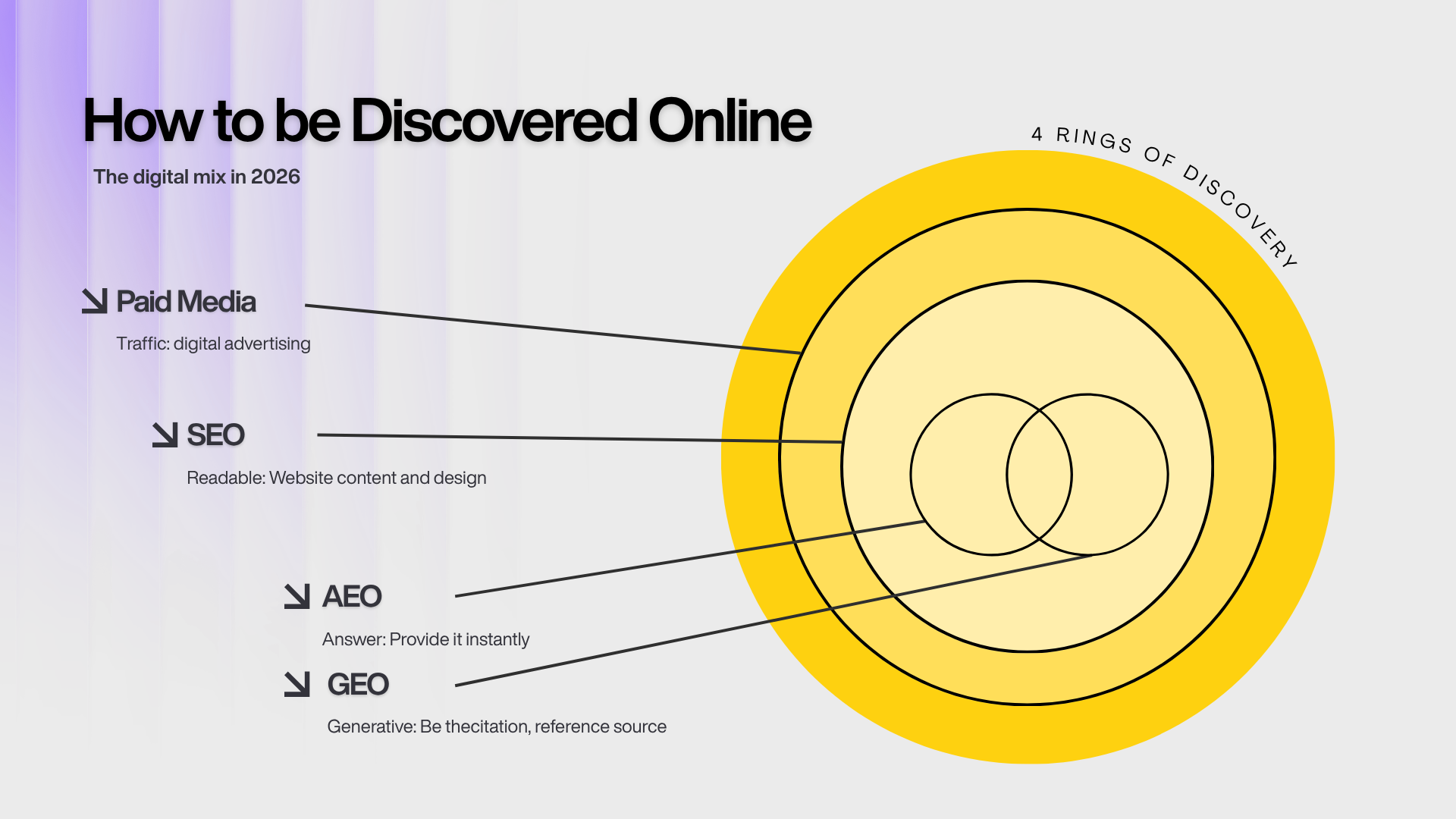
So, GEO being generative, AEO referring to answering engines, basically. So, the AI that is built into the search engines that we commonly use, like Google, Bing, Microsoft products, etc. So, with SEO, you're focusing mainly on your website, the data that you're able to collect there.
You're wanting to mainly focus on that traditional SEO strategy, where things change when you're getting to those answers, providing answers instantly through AEO. Then, GEO being generative, you want to focus on becoming a newsworthy source that can be a trusted site, a cited source. Paid advertising still is worth a lot of clicks to drive targeted traffic to your website, but using all of these together is what's going to help you remain discoverable on the internet in such a competitive landscape, really.
[Andrew]
Yeah, I would say the big takeaway at South by Southwest is always embrace serendipity. I had a lot of great unplanned meetings and interactions at the music clubhouse. Just make yourself present at these gathering places, be it the clubhouses for particular conference tracks, or be out and about on the town at the showcases.
[Katy]
That's such a great point, because Andrew and I went to a comedy show one night and we actually befriended two guys that happened to be volunteers. One had been, I think, a volunteer for 10-15 years. The other guy was a second year.
We were all waiting it was very windy and very cold, but we took that time to just chat with them, learn more about their experience on the back end as managing a lot of the volunteer work. I think in that almost elevated the experience itself by having this kind of humanistic connection that we would not get anywhere else and realize like, oh, I'm going to have a much better experience and more personal experience by talking to these guys and, I guess, networking in a sense, but more so just feeling I'm staying connected within the communities that South By presents.
[Halie]
Katy, what kind of advice would you give to businesses based on what you learned at South by Southwest?
[Katy]
I went to a balance of marketing sessions like Halie did, where I did a lot of focus on AI search and SEO. That's why Halie gave you that lovely analysis. I also did a lot of sessions on just the workplace culture and how we are taking care of ourselves in a technological age of AI.
It is still finding kind of the humanity within yourself, which I actually went to a session about that, and that's just making sure that you're being mindful of the AI content that's being also fed to you as either a business or a consumer, you know, because now we're in the age of AI hallucinations where sometimes facts are presented to you through an AI search that actually aren't accurate.
So, for businesses, it's really important to make sure you are actually combing through everything. If you're going to utilize AI, then you comb through everything you're going to post.
It haunts me that I've heard of other people where they will just create some text and publish it without any oversight, any viewing, and just kind of assume because it either hits a word count or kind of slightly covers a topic of choice, it's okay. I think that it's so important for marketers to understand that AI is a tool that will enhance your workflows and potential creativity, but it is not meant to take over you. Like, you still have to put in the work and make sure that you are driving AI and AI is not driving you.
[Andrew]
Absolutely.
[Katy]
Another interesting session that I went to kind of talked about how to optimize your brand in the age of AI, and one of the best pieces of advice that I think I got from all of South By was to stop it with the word salad. You know, just people are using these overcomplicated terms, you know, like we are an AI generative firm that specializes in content creation, you know, just you understand what they're trying to say, but why would you not just plainly spell it out?
[Halie]
People don't read and nowadays people barely pay attention. So, I think everything is about what they're perceiving of your message in a short period of time.
[Katy]
Because this talk about South by was centered around a lot of AI, I thought for a Q&A session, because I didn't have anyone submit anything, I asked perplexity questions. So, AI is our questions from the audience. So, for everyone, if a listener could change just one habit in how they use AI this year, what would you recommend?
[Andrew]
Double check everything. If you are using AI in business, you absolutely need to be double checking that output. Make sure that's accurate.
AI is very good at mimicking style. It's good at mimicking the voice of an accurate human. It's good at imitating what accuracy sounds and feels like.
That doesn't necessarily mean it actually is accurate. So, double check all that output.
[Katy]
Yeah, if you aren't proofing what you're sending out, then don't send it out. It's that is a basic skill that I hope we never lose as a society.
[Andrew]
One habit you should not necessarily change, but focus on is the intention behind using AI. Because if you're using it just to cut corners, it is obvious.
[Katy]
I'll say we had a great time attending South by Southwest. I think that we all found different pathways and sessions that really spoke to our personal work and how we can apply it in the workplace as well as in our personal lives and our relationships with technology and music and other media. And with that, the question is, why did a law firm attend South by Southwest?
It's not a legal marketing conference or an attorney conference. This is just about everything. But I think that's the point as being an internet tech and digital media law firm, we kind of have to be ahead of the curve of learning about these trends that will be in industries and businesses in order to be able to help them and stay ahead whenever new legal updates do occur.
[Andrew]
Yeah, South by Southwest really does touch on pretty much everything that our firm does. Our firm has a lot of overlap with the different programming tracks at South by Southwest. So, it was a great experience for us.
[Katy]
And honestly, I did want to change the medium of how we're going to talk about our South by experience because I went to South by and saw how experimental people are in their new content. And from a marketing perspective, I was like, why don't I try something new? So that's the reason why this exists in the first place.
This has been the KR Report. And we will see you next time when we break down something new in the legal world of internet tech and digital media.
This entry was posted on Wednesday, April 08, 2026 and is filed under Featured Media, Internet Law News.