Hundreds of Local Newspapers Sue OpenAI and Microsoft | AI Copyright Law Updates

On June 24, 2026, a coalition of nearly 400 local and regional newspaper publishers filed Richner Communications, Inc. et al. v. Microsoft Corporation et al., Civil Action No. 26-cv-5320, in the U.S. District Court for the Southern District of New York (SDNY) against tech giants OpenAI and Microsoft.
The scale of the plaintiff coalition, the specific legal theories at play, and the remedies being requested make this one of the most consequential AI copyright cases filed to date. If you're a content creator, a publisher, a business that runs a website, or a technology company with any relationship to AI, the implications of a decision on this case may matter to you.
What Is the Richner Lawsuit, and Who Filed It?
The lead plaintiff Richner Communications is a New York-based local media company, leading a remarkably diverse group of plaintiffs: 35 newspaper publishing companies representing nearly 400 outlets across 33 states. Plaintiffs include publications like the Pulitzer Prize-winning The Riverdale Press, New York City's oldest Black-owned newspaper The New York Amsterdam News, The Arkansas Democrat-Gazette (the only paper that distributes across all 75 Arkansas counties), and the Concord Monitor in New Hampshire. Many are family-owned businesses with tight budgets, local beat reporters, and deep community ties.
The complaint alleges that OpenAI and Microsoft used automated systems to copy and ingest publishers' content (including paywalled articles) to build and commercialize generative AI products like ChatGPT and Microsoft Copilot. All of this, the plaintiffs argue, was done without a single cent of compensation.
The complaint lays out three primary legal theories, each of which is worth understanding on its own terms.
AI Copyright Infringement and the DMCA
The most straightforward claim in an AI intellectual property matter is copyright infringement. Under Section 501 of the Copyright Act, anyone who exercises exclusive rights belonging to a copyright owner without authorization can be held liable. In the Richner complaint, the publishers argue that when OpenAI and Microsoft ingested their articles to train large language models (LLMs), they reproduced copyrighted works at massive scale without permission.
Important note: Microsoft does not own OpenAI, but it holds a significant minority stake and owns the computing infrastructure that powers OpenAI's LLMs. That relationship underpins the vicarious infringement theory: even if Microsoft didn't directly copy the content, it allegedly had the right and ability to supervise OpenAI's conduct and financially benefited from the resulting AI products.
OpenAI, for its part, has said its models are trained on "publicly available data" and that its work is "grounded in fair use."
DMCA and the CMI-Removal Theory
The second major legal theory is a claim under Section 1202(b)(1) of the Digital Millennium Copyright Act (DMCA), which prohibits the intentional removal or alteration of copyright management information (CMI).
What is CMI?
Copyright management information (CMI) is the metadata attached to a piece of content that tells you who created it and who owns it. Under the statute, CMI includes the author's name, bylines, copyright notices, terms of use, and similar identifying information. When you read a newspaper article online, the byline at the top and the copyright notice at the bottom are both CMI.
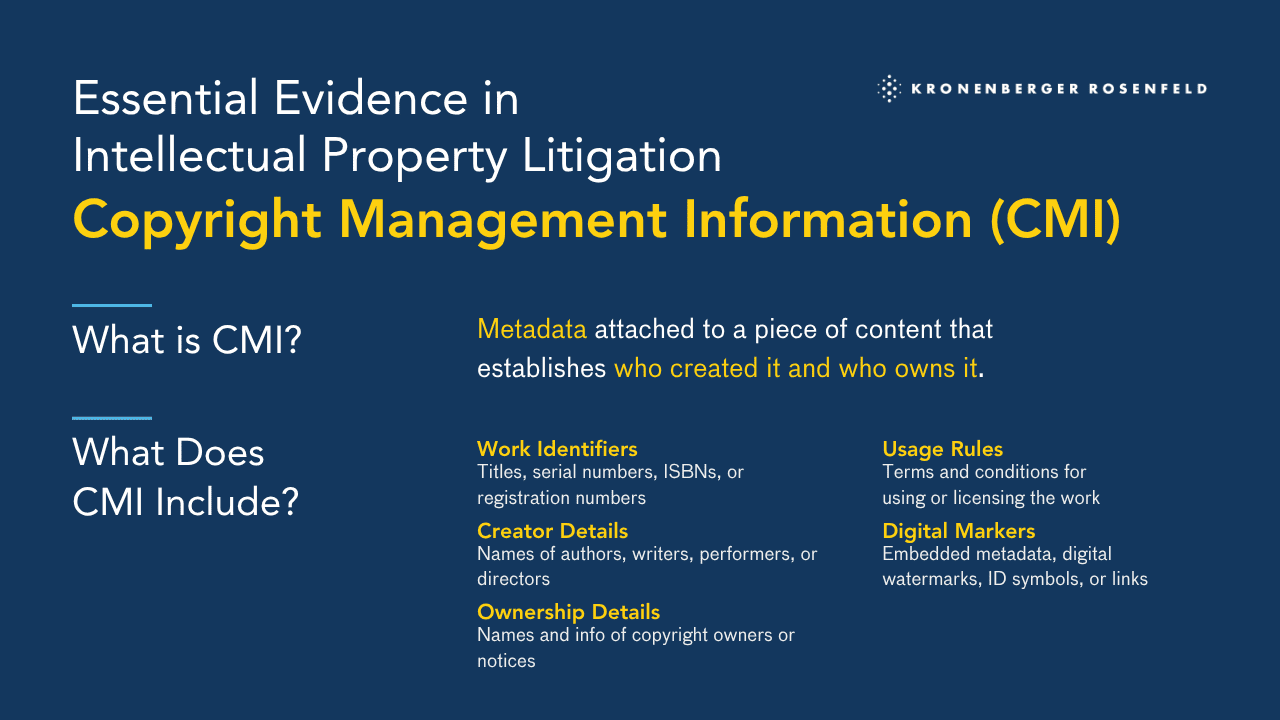
The complaint alleges that as OpenAI and Microsoft ingested publisher content, their automated systems stripped out these bylines, copyright notices, and terms of use before using those stripped works to train and commercialize their AI models.
Why does this matter? Because § 1202 operates independently of traditional copyright infringement. It creates its own category of liability with its own statutory damages: between $2,500 and $25,000 per violation. And in a case involving hundreds of publications and potentially millions of articles, those per-violation damages can compound dramatically.
The Richner complaint is carefully drafted to explicitly plead the claim under § 1202(b)(1) and ties the CMI removal directly to the downstream commercialization of ChatGPT and Copilot, which are core products that have generated enormous revenue for the defendants. Whether this framing survives a motion to dismiss is the question that will define § 1202's role in AI litigation for years to come.
Can You Make an AI "Forget"?
Of all the legal claims in this complaint, the most operationally dramatic is the request for an injunction under 17 U.S.C. § 503(b). This provision allows a court to order the destruction and removal of infringing articles from AI models and training datasets. This means the publishers are asking a federal court to order defendants to remove copies of the plaintiffs' registered works from the GPT and LLM models themselves, not just from servers or databases.
But is that even possible? It’s one of the most contested questions in AI law right now. LLMs don't store articles the way a hard drive stores a file. They encode patterns from training data into billions of numerical parameters, called "weights." You can't simply delete a row from a table. Achieving actual removal would likely require retraining models from scratch using cleaned datasets, which would be extraordinarily expensive and time-consuming.
But that's precisely the point from the plaintiffs' perspective. The legal argument is: if you built your billion-dollar product by incorporating our stolen content, you don't get to keep the benefit of that theft simply because unwinding it is inconvenient. A § 503(b) remedy forces both the court and the defendants to grapple with the actual cost of the alleged infringement.
Future plaintiffs watching this case can incorporate similar § 503(b) demands, and the more courts are asked to consider it, the more pressure mounts on AI companies to implement proactive content-licensing frameworks. It transforms "pay us for what you used" into "return what you took."
What This Means for Content Publishers and Website Owners
If you run a website, publish original content, or operate any kind of digital media property, the Richner case has practical implications for you right now.
Robots.txt and crawler controls matter. One of the underlying issues in this case is whether AI companies honored or circumvented publisher restrictions on automated access, including paywalls. Reviewing your robots.txt configuration, your terms of service language around automated access, and any paywalled content controls is potentially relevant evidence in litigation.
CMI should be explicit and consistent. The § 1202 theory in this case turns on whether copyright management information was present and was removed. If your site's articles don't clearly display author credits, copyright notices, and terms of use, you may face difficulty asserting CMI-removal claims in the future.
Licensing may become the norm. Several major AI companies have already entered into content licensing agreements with large publishers. The trend toward litigation may accelerate pressure on AI developers to extend licensing frameworks to smaller and regional outlets.
Where Is AI Copyright Law Heading?
This is a field that’s changing faster than any court can adjudicate. What we can say with reasonable confidence is this: the Richner filing represents a maturation of the litigation landscape. Early AI copyright cases were filed by individual authors and artists. The second wave brought major media companies. Now we have coordinated coalitions of hundreds of local publishers, represented by sophisticated counsel, advancing carefully constructed legal theories with both monetary and operational remedies.
The § 503(b) model-removal injunction theory may or may not survive in Richner. But the mere fact that it's being demanded with increasing frequency will shape how AI developers architect their training pipelines, how they approach licensing negotiations, and how they respond to copyright notices going forward. Think of it this way: whether or not a court ever orders a model to "forget" specific content, the credible threat of that remedy is already changing behavior.
AI Copyright Litigation and Compliance
At Kronenberger Rosenfeld, we work at the intersection of internet law, intellectual property, and technology, placing us in a front-row seat to how these cases develop and how they affect businesses across industries. Whether you're a content publisher wondering how to protect your work from AI ingestion, a technology company assessing your exposure under the DMCA, or an organization trying to understand how to structure AI content licensing arrangements, these are exactly the conversations we're having with clients right now.
Have questions about how AI copyright litigation might affect your business? Contact our team to start the conversation.
This entry was posted on Monday, August 10, 2026 and is filed under News, Internet Law News.