Navigating Intellectual Property Law in an AI Future

Summary of Major Cases at the Intersection of Artificial Intelligence and Intellectual Property Law in 2025
Bonus: Guidance on Compliance in 2026
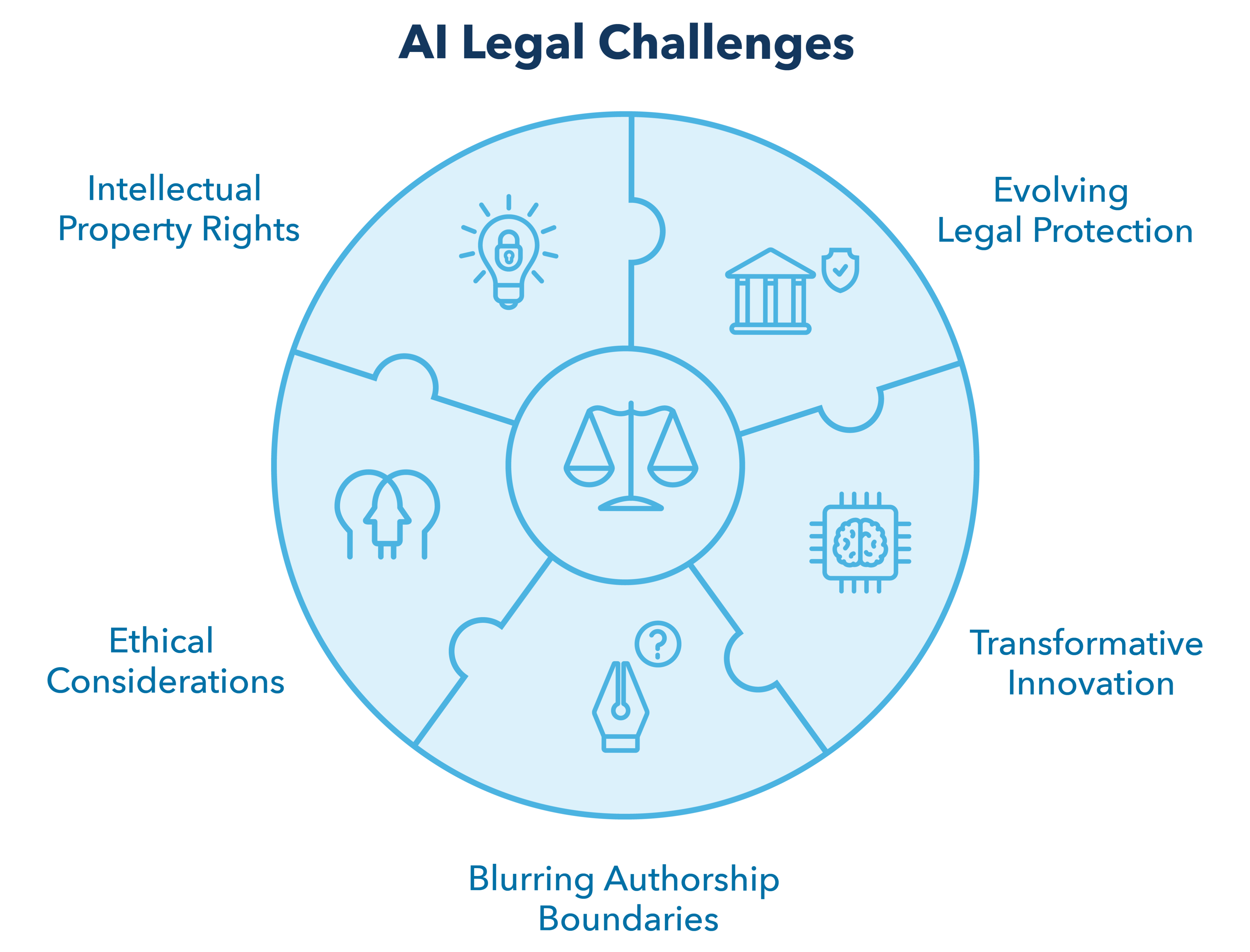
With something as transformative and fast-moving as artificial intelligence (AI), the relevant legal frameworks are scrambling to keep up. As AI systems learn to mimic human creativity, the boundaries between human and AI artistic ownership begins to blur – ultimately spurring questions around ethical and legal rights to the products being created.
Why Intellectual Property Law Matters for AI
Intellectual property (IP) law is centered around issues of ownership, protection, and fair use. But with generative AI now producing so much content, including music, stories, code, and even hyper-realistic celebrity “cameos,” the established rules undergirding IP law are being tested. Also, as more content is being put into AI tools, there are growing and evolving questions surrounding ownership and fair use of the content being put into AI tools.
In other words, AI companies are under scrutiny for how they access data, and whether that data is public vs. private and protected, and those holding IP rights in content being used with AI tools need to be vigilant to protect those IP rights as AI tools are used more and more.
Learn about some of 2025’s more newsworthy cases at the intersection of AI and intellectual property ownership, particularly in the trademark and copyright context. These lawsuits underscore a growing need for robust compliance frameworks and legal expertise from experienced AI compliance lawyers and/or experienced IP lawyers.
Cameo v. OpenAI Lawsuit
In October 2025, Cameo—a platform best known for personalized celebrity videos—filed a landmark lawsuit against OpenAI. Cameo claims OpenAI’s new AI-powered video app Sora, features a “Cameo” tool that lets users create celebrity-like videos. Cameo argues that this tool infringes its trademarked name and has created widespread consumer confusion.
Trademark Confusion and Brand Identity
Cameo’s core business model is selling custom celebrity video messages—so when OpenAI introduced its “Cameo” feature for creating AI-generated celebrity videos, the platforms collided. Cameo argues that the AI version dilutes its brand and risks misleading users. This lawsuit highlights one of the many ways AI is challenging trademark law and making headlines against other tech companies.
Copyright, Ownership, and AI
Copyright is designed to protect creative works, but most laws still require a human author. Given the impact AI is having on copyright law, the U.S. Copyright Office has released an extensive, three-part report specifically about AI (outlined in this report by the U.S. Copyright Office).1
Human Authorship vs. AI Generation
Because U.S. copyright law still requires a human author, purely AI-generated art cannot, as a general matter, be copyrighted in the U.S.—a principle reaffirmed as recently as 2023. Copyright AI Policy, 88 Fed. Reg. at 16192. However, as was demonstrated in a January 2025 decision from the Copyright Office involving Invoke’s Founder Kent Keirsey’s graphic composition entitled “A Single Piece of American Cheese,” if a person significantly shapes the final output of AI generated art with prompts and unique human input, they may be considered the “author,” thereby qualifying them for copyright protection.
Reddit v. Perplexity AI
Reddit’s recent lawsuit targets Perplexity AI after it allegedly scraped content of Reddit users indirectly by using Google search results as a workaround when direct access was blocked. Reddit’s innovative use of a “honeypot” post (visible only via Google) provided what they claim is digital proof that Perplexity’s retrieval pipeline sourced data through search scraping.
Vaults, Armored Trucks, and “Data Laundering”
To prove the alleged argument, Reddit uses an analogy: think of its servers as a vault and Google’s search index as an armored truck carrying previews. By pulling data from Google’s cache, Reddit alleges Perplexity essentially “robbed the armored truck.” The lawsuit brings in new terminology—like “data laundering”—to describe scraping content from public search indexes to obscure its origin. This framing could influence how future courts approach digital chain-of-custody and responsibility for intermediary services.
AI Content Licensing Loopholes
Reddit’s licensing agreements with companies like OpenAI and Google demonstrates how content owners should be ensured with both legal certainty and data integrity through formal licensing (learn more about content licensing). In contrast, Reddit alleges that Perplexity’s strategy of extracting data indirectly from Google’s cache attempts to bypass these emerging licensing models, arguing that just because content is visible online does not make it free or available for anyone’s use.
Perplexity asserts it operates in full AI legal compliance, stating that it aggregates publicly available data under fair use and open access principles, and argues that collecting Reddit content displayed on Google does not violate Reddit’s terms or applicable law.
Along similar lines, both the New York Times and the Chicago Tribune also sued Perplexity Ai in December 2025, and at the heart of the lawsuits is the claim that Perplexity “scrapes,” stores, and reuses content belonging to the newspapers.
Universal Music Group Settles with Udio
The legal conflict arose from the core business model of generative AI. UMG, along with other major labels like Sony Music and Warner Records, sued Udio and another AI song generator, Suno, for copyright infringement. The record labels alleged that these AI platforms had trained their models with copyrighted songs without obtaining permission or providing compensation to the artists and songwriters who created the music.
The Outcome of UMG Vs. Udio
Universal Music Group (UMG) announced on October 29, 2025, that it had settled its copyright infringement lawsuit against Udio. Following the settlement, the two companies revealed they would collaborate on a new suite of licensed creative products, marking a significant move toward partnership between the music industry and AI developers.
Partnership between Music Industry and AI
The settlement between Universal Music Group (UMG) and Udio marks a pivotal moment in the complex relationship between the creative industries and artificial intelligence developers. The deal, announced in October 2025, resolved a major copyright infringement lawsuit and established a new collaborative partnership, offering a potential blueprint for collaboration between AI and intellectual property.
The New York Times v. OpenAI and Microsoft
In 2023, The New York Times filed a major lawsuit against OpenAI and Microsoft, alleging that millions of its copyrighted news articles were used to train the AI models that power ChatGPT and Microsoft's Copilot. The Times alleges that these AI systems now directly compete with its journalism by generating answers based on its reporting, which harms its business by devaluing their content.
Ongoing Copyright Claims
In April 2025, the court largely denied the defendants' motion to dismiss, allowing the central claims for copyright infringement and trademark dilution to move forward. The case has been consolidated with other lawsuits filed by news publishers and remains ongoing.
Disney and Universal v. Midjourney
In June 2025, major Hollywood studios Disney and Universal filed a landmark lawsuit against Midjourney, an AI image generator. They accused the company of "direct and secondary copyright infringement" for using their protected characters and artworks to train its AI models, including well-known images from The Simpsons and the Star Wars franchise.
In August 2025, Midjourney denied all claims by asserting its training practices are protected under the "fair use" doctrine. The company argued that its AI does not store copies of images but learns statistical patterns, similar to how human artists are influenced by other works. They also argue many of its outputs could be considered legitimate forms of expression, such as parody or fan art. The lawsuit may force courts to decide whether scraping public images to train a commercial AI model qualifies as "transformative" fair use or constitutes mass infringement.
A victory for the studios could compel AI developers to license their training data from copyright holders. A win for Midjourney could affirm the legality of current AI training methods and accelerate the integration of generative AI even further. These cases stand as a critical test of how copyright law will apply to generative AI in the visual arts.
These cases provide a roadmap to some of the key issues that have emerged as AI becomes a greater part of everyday life.2
As cases similar to this continue to emerge, businesses should aim to seek law firms that have subject matter expertise in the key, emerging areas impacted by AI, including legal compliance, privacy, and intellectual property law.
Guidance for AI Legal Compliance in 2026
Policy to Practice
An AI compliance lawyer bridges the gap between cutting-edge technology and established legal frameworks. Some tactics include:
- Auditing AI models
- Ensuring responsible training practices
- Reviewing intellectual property agreements
- Educating teams about potential risks
- Pursuing or defending against IP claims, particularly in the copyright and trademark context.
With rapid advances in generative AI, legal guidance is critical—not just for developers, but also for marketing, management, and anyone utilizing AI in their businesses.
How California Privacy Laws Shape AI Conversations
California’s privacy regime, especially the CCPA, now sets national standards for data and IP compliance. The state’s aggressive enforcement aims to set a standard for AI-related disputes. Developers must watch for brand dilution, copyright infringement, and the accidental use of protected material in training datasets. Prevention is always better than litigation—and routinely reviewing AI legal compliance policies can reduce risk down the line.
Staying Ahead with AI Legal Compliance
AI compliance lawyers and IP experts are now critical decision makers in tech firms. They help navigate data acquisition, licensing, and IP protection so companies can innovate without crossing legal boundaries. Staying current through legal updates is a must for any business competing in today’s market.
How to Prevent Infringement by AI
Worried your usage of AI might create something that raises potential legal risks? Make sure to always consider at least the following:
- Documenting human involvement in every creative process
- Vetting training data for copyrighted, trademarked, or personally identifiable information
- Offering clear disclosures to users, especially about the use of celebrity likenesses or branded content
Resources for Navigating IP Uncertainty
Intellectual property law is facing its biggest crossroads yet with the rise of artificial intelligence. These AI/IP lawsuits are setting precedents for trademark, copyright, and compliance disputes in the coming years. Whether you’re a developer or a business owner, now is the time to sharpen your understanding of AI legal compliance with the help of trusted experts. Contact Kronenberger Rosenfeld, LLP today to discuss your AI compliance needs.
This entry was posted on Thursday, January 22, 2026 and is filed under Resources, Internet Law News.